
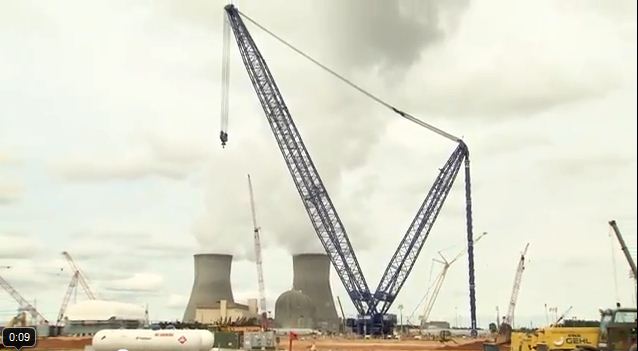
America’s first new nuclear energy reactors in 30 years are currently under construction at the Alvin W. Vogtle Electric Generating Plant in Burke County, Georgia. The ANS Nuclear Matinee takes viewers behind the scenes of this amazing project (courtesy of Southern Nuclear Company who produced the excellent video updates).
An on-site railroad, one of the world’s largest heavy lift derrick cranes, massive turbines, condensers, cooling towers… news from the AP1000 reactors under construction in China… and even a tour of Vogtle’s amazing nuclear reactor and plant simulators… it’s all here in this Vogtle construction update:
Vogtle construction highlights featuring US Secretary of Energy Dr. Steven Chu:


Smarter Cleaner Energy Sources……that ain’t nuke boys and girls.
Solar at 3 cents per kWH has a much higher annual rate of return, these new nuke plants, if they are ever started will only return 1.666% annual rate of return, as the GE pres says, nuke no longer makes economic sense.
GE has that opinion because the profit margin on subsidized wind turbines manufactured in China is larger. However, as a reliable energy source, wind and solar are shit. They have 30% and 20% capacity factor respectively, compared to 91% for nuclear.
With attitudes like yours, we will have a country full of Rancho Secos. If you didn’t know, Rancho Seco was a 900 MW nuclear plant closed in the late 80′s in California due to unpopular public opinion. In its place, the utility installed one of the largest arrays of solar photovoltaic installations in the world at the time. It has a capacity of 4 MW. Not even a half of one percent of the nuclear plant upon which it is built. It’s no wonder California is crippled by the highest energy costs in the nation and is forced to purchase power from neighboring states.
Further evidence – Italy closed down its nuclear plants shortly after Chernobyl. They currently import their power from France (70% nuclear generated) and enjoy some of the highest electricity costs in the EU, while France suffers through the lowest energy prices in Europe. Germany recently voted to transition away from nuclear power and have begun closing down plants. Thanks to large installations of wind and solar power that have proven unreliable for baseload energy needs, combined with shuttered nuclear plants and high natural gas prices in Europe, Germany has turned on old coal plants to generate enough electricity to power its country. That’s correct – in Germany’s bid to rid itself of nuclear and rely on renewables, it has fallen back on dirty coal, throwing fly ash, sulfur, arsenic, mercury, and CO2 into the air. However that’s still better than Japan, which is reeling from the tsunami that took out Fukushima. The accident dominated the news, even though zero deaths are currently attributed to radiation exposure, compared to 20,000 deaths during the earthquake and tsunami. In their haste, they shut down every single one of their nuclear plants out of fear. They have been unable to keep up with electricity demand with other generation sources, so they have resorted to energy rationing through blackouts. To cope with the heat of summer, employers in Japan have allowed employees to wear shorts in the office. The Japanese utilities have begun starting up the closed nuclear plants again because of the backlash. They recognize they absolutely must have that vital electricity source.
This is what happens when politics trump science and facts.
So Steveo, the vendor may have higher profit margins on wind and solar thanks to illogical government subsidies, populist rhetoric, and fear, but the end-user pays more for worse reliability. A world without nuclear energy is one with higher energy costs and a lower standard of living. As such, nuclear power will always be an important part of a country’s energy portfolio.